THE FAMILY TABLE
Hosted by the Karen Organization of San Diego (KOSD) and the Teaching and Learning Collaborative (TLC) , The Family Table was a STREAM-centered (Science, Reading, Technology, Engineering, Arts, and Math) summer program that brought together refugee students and families from Burma (Myanmar). Through facilitated, hands-on projects, students built toward a culminating exhibit that celebrated learning, heritage languages and cultures, and the everyday acts of connection that happen around the family table.
Karen Organization of
San Diego
A grassroots organization founded by Karen refugees and allies, KOSD supports refugee families from Burma as they build new lives in San Diego. Rooted in cultural preservation and mutual care, KOSD advances educational, civic, and economic opportunities through language and culture classes, youth programs, and partnerships with local organizations and schools, while honoring the traditions and histories of its diverse community.
KOSD's youth programs provide ongoing guidance and support for Burmese refugee students with a focus on helping them build positive networks of support with one another in order to develop pathways to academic success, higher education, and career-building skills.
Teaching and Learning Collaborative
A team of professional educators committed to transforming education through equity, creativity, and community collaboration. TLC designs programs, learning spaces, and professional development opportunities that center marginalized students’ brilliance and honor the knowledge families and communities bring to the table.
TLC partners with schools and community organizations to create culturally sustaining, asset-based learning experiences that empower newcomer, refugee, and housing-insecure youth to thrive not only academically but socially and emotionally.


The Summer Program
Every summer since 2021, KOSD and TLC have partnered together to develop education-based summer programs for youth in KOSD’s community of refugees from Burma. Supported through the San Diego Unified School District’s Level Up initiative and the San Diego Foundation, the program offers TK–6th grade students (4-12 year olds) the opportunity to explore STREAM subjects through hands-on and culturally-sustaining projects. KOSD community members and high school interns provide the cultural and linguistic knowledge needed to support these youth in learning both Burmese and English language curriculums, while TLC Teaching Consultants contribute their experience in student-centered, inclusive pedagogy. Together, they co-create community building programming and curriculum that center heritage languages and cultures.
This partnership works because each organization brings expertise the other doesn't have. "We have expertise but we're not the experts," says Bailey Choi, TLC Program Manager, of TLC's approach to curriculum design. KOSD brings that missing piece: the cultural knowledge and community insight to make sure the curriculum actually serves the community it's built for. As Nao Kabashima, Executive Director of KOSD, explains, TLC stays in constant communication with KOSD as they develop the program to ensure that the curriculum is aligned with the community's values and needs.
Each summer centers a specific theme— past years have explored themes of Flight, Oceans, and The Future, all with STREAM approaches. In every case, the classroom transforms into sites of shared learning, where refugee youth are able to advance their learning in STREAM subjects while centering the knowledge, cultures, and communities that they come from.
The Family Table Theme
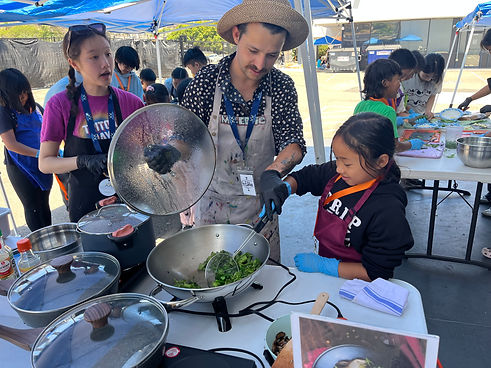
In the summer of 2024, the program included a cooking and gardening component that turned out to be very popular with the youth and their families. The organizers decided to build on this success by centering their 2025 summer programing around a “Family Table” theme.
KOSD organizers worked alongside students and TLC educators to consider and develop projects around the following questions:
-
Who is at your family table?
-
What is on your family table?
-
What do you eat at your family table?
-
What other activities do you do at your family table?
-
How do you welcome people to your family table?
TLC teachers facilitated hands-on activities that focused on familial, culinary, community, and school-related activities that happen around the family table. “The direct connection to the students' experiences at the Family Table was very meaningful. Traditions, lineage, history, recipes, and more emerged organically from the hands-on projects,” says Caren Holtzman, Executive Director of TLC.
In addition to the STREAM-centered curricula, KOSD organizers created Karen and Burmese-specific curricula taught by community members, according to KOSD Level Up program manager Mu Aye. For example, elders came in to read books with the students and tell stories about their experiences in Burma and through displacement, while expert basket-weavers, some of whom were mothers of students in the program, came in to teach a course on basket weaving, a traditional Burmese practice.
This year, the program was hosted at The Partnership for the Advancement of New Americans (PANA) in City Heights. “It was a true collaboration between TLC, PANA, and KOSD to transform the space into a learning environment for youth and to bring together such a rich and meaningful program. The program was a striking example of how "education" and "community" can come together to do powerful, beautiful work,” Caren adds.
The students’ work came together to form one long community table at the culminating celebration (see right). This table acted as a visual centerpiece of collective learning and multigenerational storytelling.


The Culminating Event
Alongside this programming, KOSD staff also facilitated language and cultural classes for students. This programming is especially important for young refugees, many of whom were born in refugee camps or outside of Burma. It helps sustain their cultural and community connections while navigating displacement. During these sessions, students learned about Karen and Burmese languages, songs, dances, traditional clothing, and games.
The culminating event was intergenerational, bringing together students, parents, grandparents, members of the Karen community, and broader refugee community members connected to KOSD.
In addition to the Family Table installation, the exhibit featured performances by the students based on the Karen and Burmese traditions that they had learned about through the program. Kabashima explained that the original catalyst for this program was to bring Burmese and Karen linguistically and culturally sustaining education to their youth, and that "parents feel more confident, more encouraged to support their kids' English education" when they know their children can be "100% Karen and 100% American at the same time."
The celebration demonstrated how learning, culture, and community are inseparable in refugee-centered educational spaces.
Why It Matters
This summer program is a powerful model for community-centered education that doesn't just bring communities into predetermined curriculum but actually develops that curriculum alongside the community. Not only did their curriculum incorporate the community's knowledge and cultural practices as valuable and legitimate as STREAM curriculum, but, as Kabashima told us, their "community's culture is actually strengthening the STREAM curriculum. And our parents are so happy to see that and the students are so happy to learn".
The Family Table theme could not have occurred without iterative feedback from the community that the summer program aims to support. It also illustrates what becomes possible through collaborative infrastructures for education. Teachers, families, community organizers, and youth from the Burmese community all worked together to make it happen. The cultural and linguistic expertise of KOSD staff and insight from student families and community alongside the teaching expertise of TLC educators allowed them to create culturally responsive curriculums for STREAM subjects by integrating home languages, home stories and histories, recipes, and community practices like art and dance all in the same environment.
By honoring this knowledge, the program demonstrates what Critical Refugee Studies called “refugee teaching”: recognizing refugee students and their families as sources of knowledge rather than problems to be solved. The learning in this summer program occurred through community-building activities rooted in the daily lives and knowledge of the community itself, rather than outside of or despite the community. Even PANA offering the program a space when existing infrastructure was cut demonstrates the importance of collaborative programming, particularly for marginalized communities whose funding and support is often at risk. The culminating family table made up by the community at large signifies that learning is a shared practice, not an individual one.
This program can also help us expand our understanding of where and how education happens. These powerful learning moments did not need to happen in traditional school spaces or through textbooks. They occurred in intergenerational community spaces. The Family Table demonstrates that education can happen in community centers, kitchens, gardens, and even gathered around a shared table.
Refugee communities carry deep knowledge shaped by movement, memory, and community. When programs make space for that knowledge, young people become teachers as well as learners.
“It was a striking example of how education and community can come together to do powerful, beautiful work,” Holtzman said.